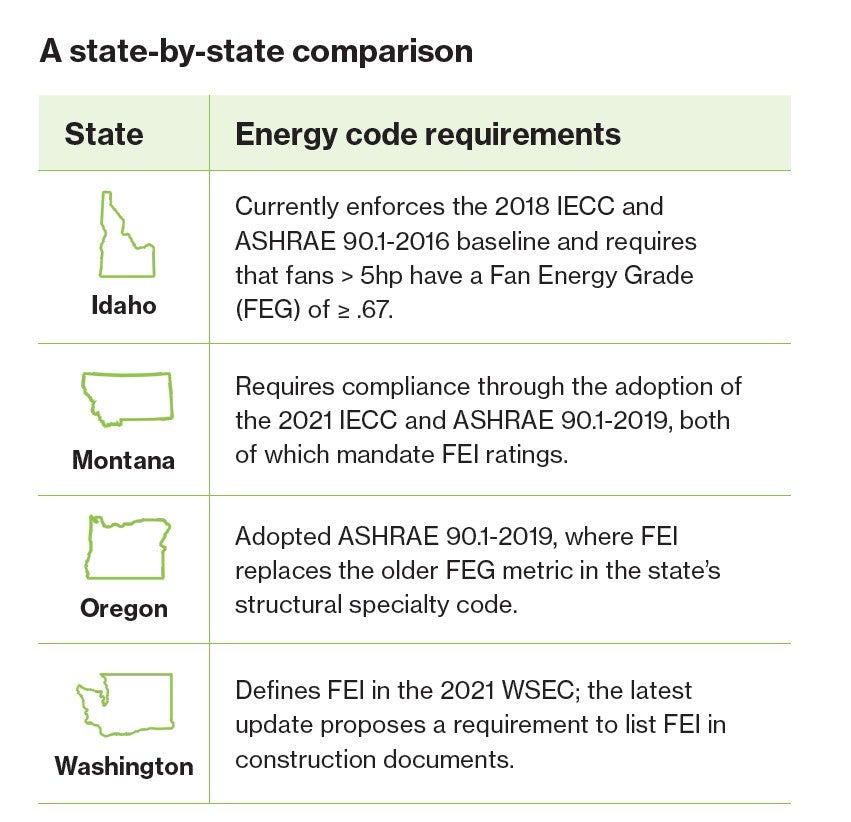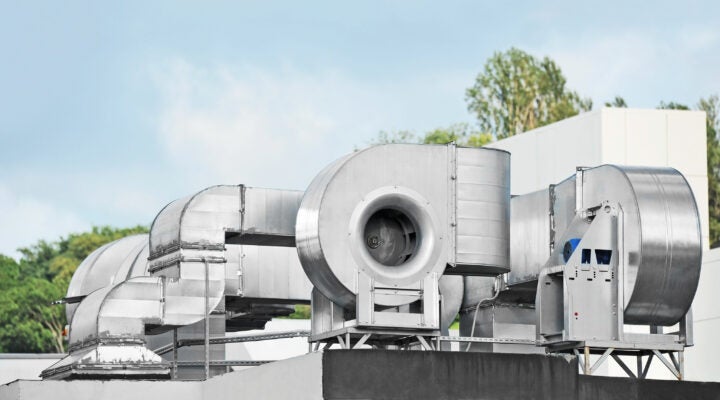
Northwest building professionals should know that the Fan Energy Index (FEI) is a standardized metric for comparing the energy efficiency of complete fan systems at a specific duty point. It is required in jurisdictions that have adopted commercial-building model energy codes, such as the 2019 edition of ANSI/ASHRAE/IES 90.1 or later, and/or the 2021 edition of International Energy Conservation Code (IECC) or later. FEI is also written in the 2021 Washington State Energy Code (WSEC).
Manufacturers, specifiers, engineers, designers, and building owners must select fans with an FEI rating of ≥ 1.00 or higher to comply with code.
Why comply?
As code enforcement tightens—often driven by stronger education and awareness in the market—the need for engineers and specifiers to be aware of and comply will increase. Beginning with the 2025 ASHRAE 90.1 edition, fan FEI ratings must be clearly listed on construction documents, making the metric easier to see, carry through, and enforce. According to Michael Ivanovich, Senior Director, Advocacy and Education, with Air Movement and Control Association International, Inc. (AMCA International), “FEI is the energy performance metric required by the U.S. Department of Energy test procedure embedded in the U.S. Code of Federal Regulations. The procedure governs the Method of Test document, and the FEI metric for commercial and industrial fan energy performance. Other parameters may be used, but the FEI rating must accompany them.”
It is important to note there is neither a federal minimum FEI level for fans, nor compliance-filing or labeling requirements for manufacturers. Except for California’s FEI-based Title 20, only model and state energy codes have FEI requirements.
Strengthening your understanding and application of the FEI metric now, rather than waiting for stricter enforcement, can help you avoid penalties levied for not following the law.
Why start now?
Taking a proactive approach to compliance by incorporating FEI early has advantages beyond meeting code minimums. It allows you to:
- Build familiarity with where and how to add the metric to construction documents can provide more lead time for updating internal spec books, software, and other materials needed for project guidance. Waiting until code enforcement increases to make these important updates can take a toll on valuable resources such as time and money.
- Reduce the risk of costly mistakes, project rework, and callbacks by code officials caused by rushing to comply with a recently enacted code.
- Prepare for future changes to fan models and designs as manufacturers and specifiers adapt to new code requirements. For instance, an installed fan rated below the current FEI requirement cannot be replaced by a like-for-like fan, as the replacement fan would be out of compliance.
Steps to compliance
As scrutiny, transparency, and oversight increases, here are a few tips for getting on the path to compliance:
Choose the right product: Select fans that meet the minimum FEI rating required by the energy code designated for your area.
Opt for an AMCA International-certified fan: Certified fans are independently tested to perform at a specific duty point under laboratory conditions. To re-verify their certifications, AMCA International performs the testing every three years. If the fan is not AMCA certified, ask for the independent laboratory test report. Find AMCA International-certified fans.
Put it in writing: List the FEI rating in construction drawings, equipment specifications, and equipment schedules to ensure the fan selected is what gets installed.
Key takeaway
Compliance cannot be avoided. Code officials are paying more attention to submittals and documentation. FEI is the standard metric for fan efficiency and is already required by code in many Northwest states, including Montana, Oregon, and Washington. Even in states where the metric is not yet required by code, it is required by the U.S. Department of Energy’s test procedure and must be provided whenever fan energy performance of any type is communicated.
With proposed changes to future editions of ASHRAE 90.1 and the IECC on the horizon, you do not want to fall further behind the compliance curve or be subject to penalties or delays associated with noncompliance. Act now to educate yourself about FEI and how to ensure your fan systems are compliant.