Summary
At the Washington School for the Deaf, a public K–12 campus serving deaf and hard-of-hearing students, lighting directly shapes how the environment supports its occupants. In a setting where communication depends entirely on visual clarity, the lighting system is required to be flexible. The previous fluorescent system offered limited control and created visual strain for all occupants.
“It was really bright, and it hurt the eyes. There weren’t a lot of options—It was either off or on,” said Sharon Graham, Principal of Washington School for the Deaf. “We needed more options for how we could use the lights and how we could turn them on for different activities.”
What the school ultimately required was a lighting system designed to support varied uses within the same space, delivering flexibility without adding operational complexity.
Project Overview
The adaptable solution
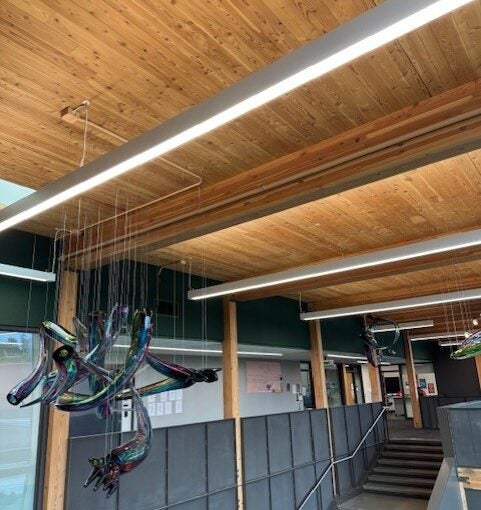
The school partnered with Mithun for design, Glumac for engineering, and Dark Light Design to implement a whole new lighting system. To meet the school’s needs, the team selected luminaire level lighting controls (LLLC), a networked lighting control system that integrates sensors and load controllers directly into each individual fixture.
“We knew that lighting and visual acuity was so crucial for this population. We emphasized low-glare, high-quality light, and made sure to incorporate lots of natural daylight,” said Jeremy Toews, Project Engineer at Glumac.
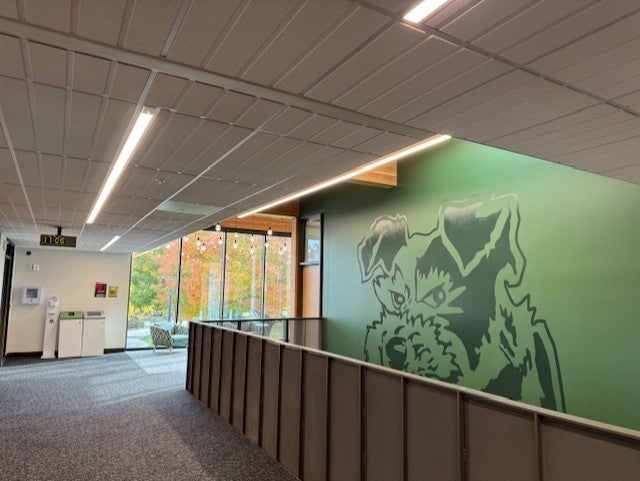
The installation and programming process was a seamless experience. An estimated 430 fixtures were installed throughout classrooms, offices, conference rooms, corridors, and the gym.
Because capabilities are embedded directly within each fixture, the lighting responds dynamically to real-time conditions. Spaces can be reprogrammed, reconfigured, or repurposed without rewiring, panel modifications, or extensive downtime.
Flexibility in action
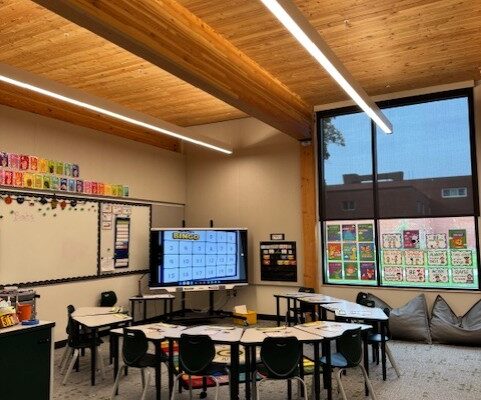
Thanks to LLLC features like dimming and occupancy sensing, teachers can now easily adjust light levels based on needs. With each fixture operating independently, the lighting can appropriately fit whatever the moment requires.
“With hearing students, you can call out or wave, but for deaf students, flickering the lights is often the most effective way to get their attention. This lighting design supports that,” said Graham. “Teachers can also adjust light levels for small groups, reading time, or simply based on what students prefer.”
The result is a lighting environment that responds to how the space is actually used rather than forcing occupants to adapt to fixed lighting conditions.
Built for the long-term
Because LLLC embeds controls at the fixture level, changes to the lighting can be made quickly and easily. This ensures lighting output aligns with actual demand, reducing unnecessary energy use while maintaining consistent performance.
“All of the lighting controls have daylight harvesting or dimmable fixtures so that we’re not using more energy than is needed to provide the level of light that’s required,” said Toews.
The system is estimated to save 320,000 kilowatt-hours annually and the project qualified for $17,208 in utility incentives from Clark County PUD. Beyond the energy savings, the system shows how LLLC futureproofs the school by accommodating changes in space use or occupant needs without major upgrades.
Proven results
A post-occupancy report found that 83 percent of staff reported an increased sense of belonging, and 75 percent of educators observed improvements in focus and engagement. While these outcomes reflect the specific needs of the school community, they point to a bigger truth about how lighting can shape a building’s performance. The success at Washington School for the Deaf shows that adaptability is not simply a feature to add at the end of a project—it is a principle that supports efficiency, comfort, and long-term resilience.
Luminaire level lighting controls provide the flexibility to meet today’s demands while remaining ready for tomorrow’s changes, helping buildings continue to serve the people inside them.
Related Case Studies
Lighting the way: Mount Vernon’s brighter, smarter library
A backstage transformation in light and efficiency