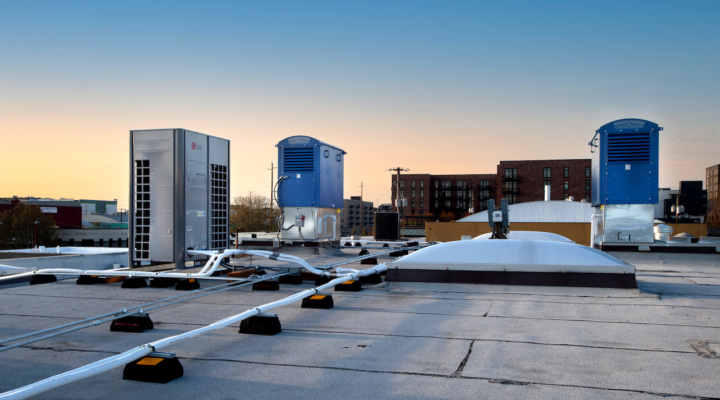
A key design component of the advanced performance dedicated outside air system (DOAS) approach—previously known as very high efficiency DOAS—the decoupling of ventilation from heating and cooling systems reduces energy use while significantly improving indoor air quality.
Every building professional understands the direct connection between a commercial building’s HVAC system and its overall energy use. However, that is just one of many impacts that an HVAC system has on not only the building itself, but also on every occupant within. In addition to the obvious link to occupant thermal comfort, a building’s HVAC system has a profound correlation to occupant health and productivity. Designing the right system can foster healthy working conditions for occupants, while also having an enormous impact on the building owner’s bottom line. When compared to code-minimum approaches, the highest efficiency HVAC systems can reduce HVAC energy use by more than 69%,[1] while also mitigating the wasted productivity when employees become stricken with airborne illnesses.
In fact, according to the National Center for Biotechnology Information, airborne respiratory illnesses, such as the flu, result in losses of $20 million per year in workplace productivity. Further, asthma and allergies cost companies and employees an additional $29 billion each year.[2]
With stakes like these, it’s no wonder that organizations like the nonprofit Northwest Energy Efficiency Alliance (NEEA) have worked rigorously to identify the healthiest and most efficient approaches to HVAC design. While NEEA and other industry experts agree there’s more than one way to design an effective HVAC system, not all systems are able to provide a healthy, comfortable interior in an efficient manner. And even the most efficient HVAC equipment will fail to live up to its potential for healthy air and efficient operations if the system design fails to optimize the way in which system components interact with one another.
After years of research and field testing, NEEA identified an HVAC design approach, referred to as advanced performance DOAS, that they have determined to be the most effective and efficient way to provide comfort and clean, healthy air to a commercial building, particularly small-to-medium-sized buildings less than 50,000 sq. ft. Among the equipment and design considerations for advanced performance DOAS—which include using a high efficiency heat/energy recovery ventilator, a high-performance electric heat pump, and a right-sized heating and cooling unit—it is the approach’s decoupling (i.e., separating) of ventilation from heating and cooling air that allows the system to provide filtered, fresh outdoor air to significantly enhance air quality and reduce viral risk. All of this is done while using less energy than relatively efficient HVAC options with the same ventilation rates.[3]
The benefits of full (and thoughtful partial) decoupling.
Separating the ventilation from the heating and cooling system is a key component to making advanced performance DOAS the most efficient and effective HVAC approach available.
And while all DOAS configurations are at least partially decoupled to provide some level of reduced fan power and improved air quality, the advanced performance DOAS approach enhances these benefits to an exemplary degree. The most profound benefits come from complete decoupling, in which the heating and cooling airflow is never in contact with ventilation airflow. However, partial decoupling configurations in which ventilation air is ducted into the supply side (as opposed to the return side) of the terminal units, also provides efficiency and air quality benefits over a coupled system.
Despite being a relatively new approach, complete decoupling is winning over even the most skeptical engineers. “Our participation with NEEA has moved me from a skeptic of decoupled ventilation and high efficiency E/HRVs to an advocate,” said Sean Murray, engineering manager and partner at Alliant Systems. “We are continuing to actively promote, design, and install this high-performing system solution.”
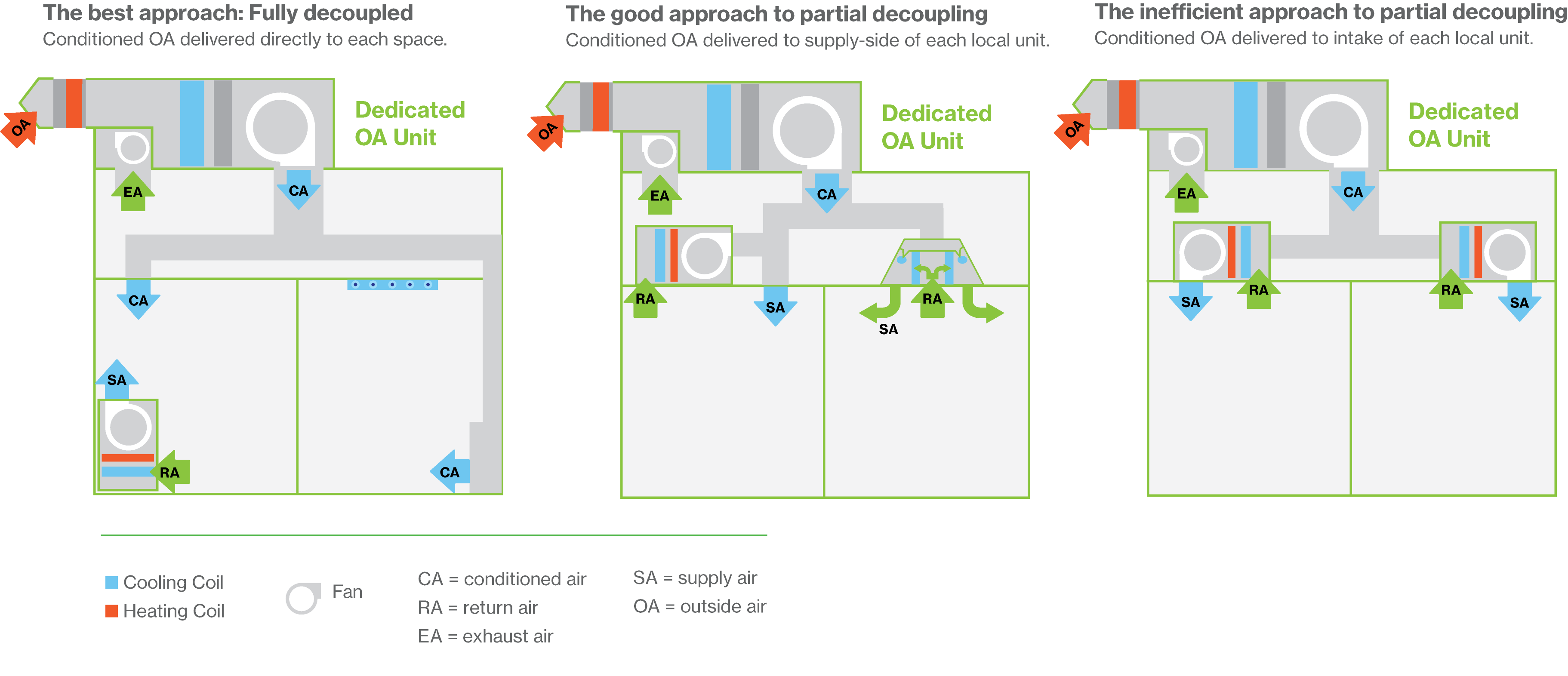
For both partially decoupled systems (with ventilation air ducted into the supply side of terminal units) and fully decoupled systems, the benefits are manifold:
- Reduced system fan energy, due to:
- Less distance to move air.
- Separate and optimized control of ventilation and heating/cooling fans, allowing each to operate less often. (Note: This benefit is most enhanced when the system is fully decoupled).
- DOAS equipment uses smaller, more efficient fans.
- Better indoor air quality, due to:
- Increased ease of ventilation airflow measurement.
- Allows for more control and efficiency when higher ventilation rates are needed (i.e., during flu season).
- Smaller duct sizes
- Note: Fully decoupled systems often require more supply diffusers.
Proven performance in the real world.
“Advanced performance DOAS provides a more consistent and higher level of ventilation through the space at all times,” said Murray. “It results in a more comfortable and fresher environment.”
These benefits are more than theoretical. Across 12 real-world demonstration projects, the advanced performance DOAS approach and its crucial decoupling design principle have proven to reduce HVAC energy use by 69% and whole-building energy use by 48%, when compared to a code-minimum system.[4]
The following case study demonstrates the performance gains that can be achieved with the right HVAC design decisions. The two office buildings (compared to the right) are within two miles of each other. Both offices share a host of similarities, including similar occupancy densities, business hours, building envelope material, and HVAC equipment (including VRFs and high efficiency HRVs with similar efficiencies).
Despite these numerous similarities, the buildings featured three key differences in HVAC design that led to dramatic differences in energy use. Namely, Office A featured three superior design features: 1) full decoupling, 2) right-sized heating and cooling equipment, and 3) aggressive temperature setbacks and dynamic equipment schedules.
| Office A | Office B |
|---|---|
| – Fully decoupled | – Partially decoupled (ventilation air ducted into fan-coil returns) |
| – Right-sized heating/cooling equipment (750 sq. ft./ton) – Aggressive temperature setbacks and dynamic equipment schedules | – Over-sized heating & cooling equipment (250 sq. ft./ton) – Conservative temperature setbacks and equipment schedules |
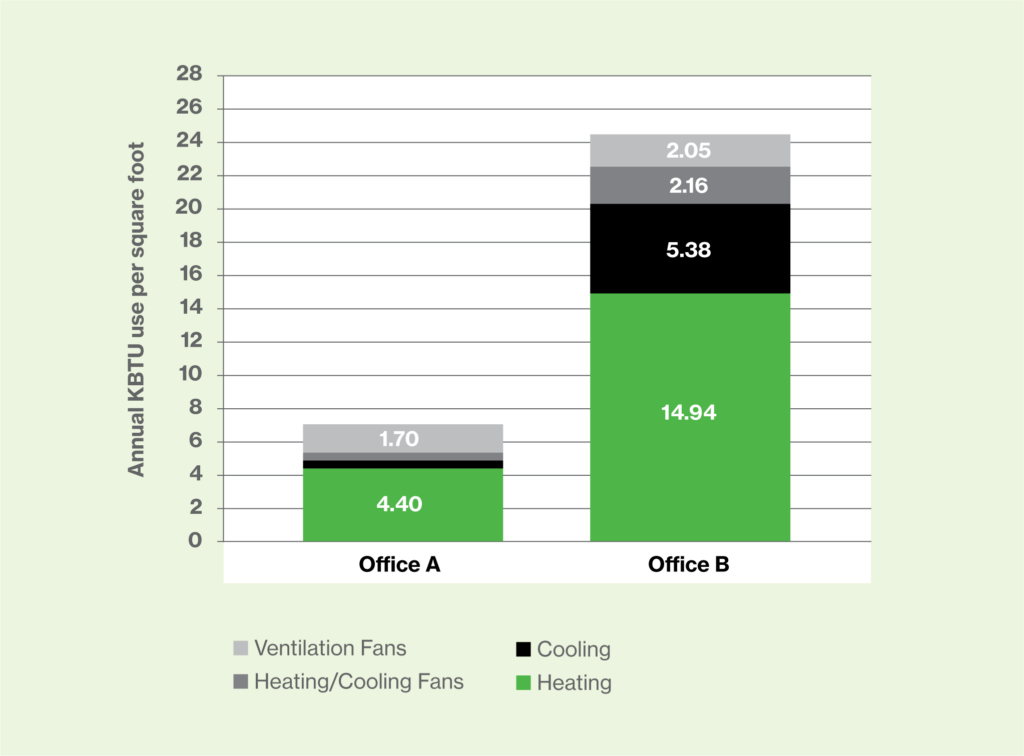
As shown below, Office B required triple the amount of energy as Office A to provide heating, cooling, and ventilation throughout the building.
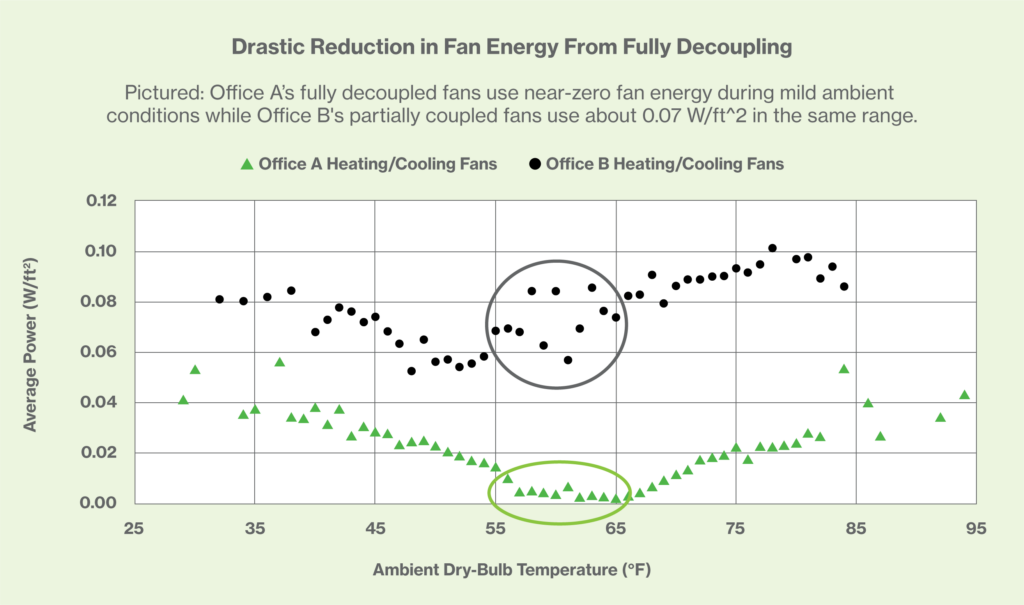
Drilling deeper into the energy usage data, the figure below shows the average heating and cooling fan energy usage compared to the outside air temperature for each building. In a one-year timespan, Office B used almost five times more heating and cooling fan energy than Office A. This is largely due to the fans in the fully decoupled Office A cycling off far more often than the fans in partially coupled Office B. This is particularly noticeable on days when the average outside air temperature is in the 55–65 F range. In this case, the heating and cooling fan energy is nearly zero, as the very little heating and cooling load allows the fans to remain off. In contrast, Office B’s fan coil units are partially coupled to the ventilation system, which means that even when the outside air temperatures are mild, the ventilation air still causes the fan coil units to experience a small ventilation load, forcing the fans to run for extended periods of time.
While it’s difficult to specifically quantify how much of Office A’s significant energy savings come from fully decoupling ventilation from the heating and cooling system, the findings are clear: when it comes to installing the healthiest, most comfortable and most efficient HVAC systems, design decisions are as important as the equipment we use. And when it comes to adopting the best-known approaches to HVAC design, decoupling should always be a key consideration.
[1] Source: Twelve real-world demonstration projects by Northwest Energy Efficiency Alliance, as compared to code-minimum systems.
[2] Source: https://pubmed.ncbi.nlm.nih.gov/29801998/.
[3] Source: Covid-19 Reduction Strategies and HVAC System Energy Impact Study. Northwest Energy Efficiency Alliance (NEEA), 2021.
[4] Source: DO AS We Say (and As We Do): Maximizing HVAC Efficiency, Flexibility, and Resiliency with High Efficiency Dedicated Outdoor Air Systems. Northwest Energy Efficiency Alliance (NEEA), 2022.