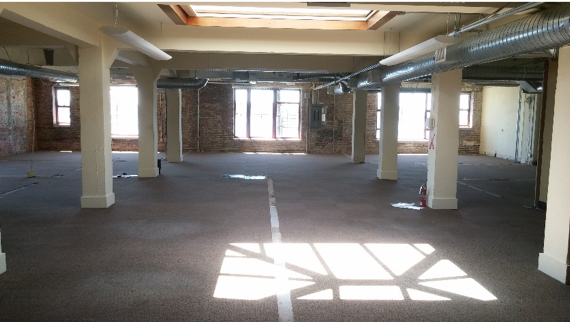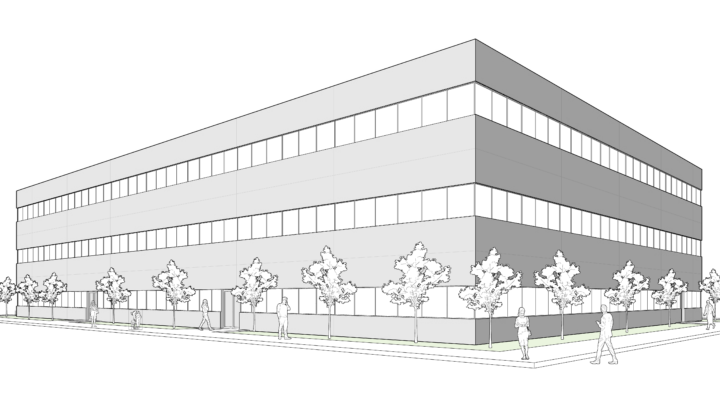
Using comparative data based on energy models, along with real-world performance data and product costs, this modeled case study illustrates the pros and cons when selecting an HVAC system for a typical mid-sized Northwest office building that meets or exceeds Washington State Energy Code (WSEC) requirements.
| Example building profile | |
|---|---|
| Type: | 3-story office building |
| Project type: | New construction |
| Location: | Spokane, WA / climate zone 5B (cold dry) |
| Size: | 53,600 sq. ft. |
| Year built: | 2026 |
Case study scenario
A three-story 53,600 sq. ft. office building is being built in Spokane, Wash. The developer sees value in energy efficiency and indoor environmental quality, but would also like to keep project costs as low as possible. The building is required by Washington State Energy Code to include a dedicated outside air system (DOAS) and the design firm is considering two systems that meet this requirement: 1) a code-minimum DOAS system with hydronic heating and cooling, and 2) an advanced performance DOAS with enhanced heat recovery ventilation (HRV) and hydronic heating and cooling.
| System comparison | Washington State Energy Code-minimum DOAS | Advanced performance DOAS |
|---|---|---|
| System design | 1100 MBH air-to-water heat pump (3) 3000 cfm HRV (68% sensible effectiveness) | 1100 MBH air-to-water heat pump (3) 3000 cfm HRV (82% sensible effectiveness) |
| Full system cost (install, equipment, permitting) per sq. ft.1 | $78.95 | $78.98 |
| HVAC / whole-building EUI (kBtu/sq. ft./yr)2 | 9.3 / 23.8 | 8.6 / 23.1 |
| Annual energy costs ($0.12 kWh) | $44,949 | $43,595 (3% reduction) |
| Incremental payback (years) | n/a | <2 |
| Carbon emissions (lbs./yr CO2_e)3 | 571,112 | 553,913 (3% HVAC reduction) |
| Air quality | • Fully decoupled heating/cooling and ventilation | • Fully decoupled heating/cooling and ventilation • MERV-13 filtered air with no recirculation delivered directly to the space |
Similar upfront cost, greater lifetime savings
In this scenario, the developer must weigh the slightly higher upfront system cost with the additional value provided by the higher performance HVAC solution, including:
-
Superior thermal comfort. With the higher efficiency HRV, fresh air is delivered to the space close to room temperature without the need for tempering, ensuring thermal comfort and energy savings.
-
Lower annual energy costs and decreased carbon emissions by 3% compared to a code-minimum hydronic system for very little incremental cost and short payback period.
-
Exceeds WSEC requirements for decoupled ventilation.
1 System costs are based on the average of two actual estimates solicited from design build mechanical contractors in 2024.
2 Red Car Analytics, Economic Analysis of Heat Recovery Equipment in Commercial Dedicated Outside Air Systems, 2019.
3 Environmental Protection Agency, eGRID2022, subregion WECC Northwest.