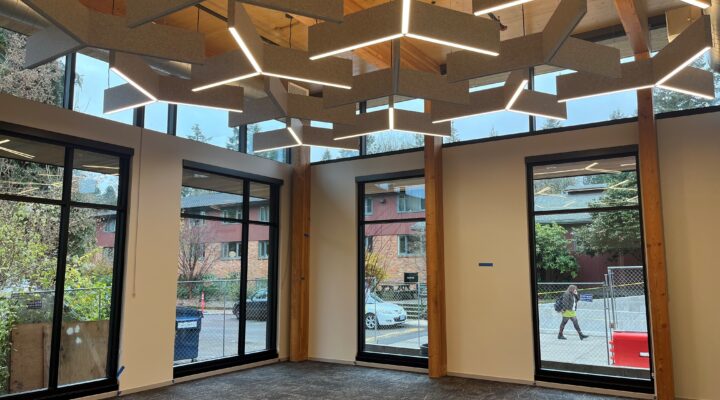
Advanced performance DOAS passes the test for indoor air quality and efficient HVAC performance.
Healthy air for better learning
Across the Northwest, many K-12 schools struggle to provide their students with fresh, healthy air. While older buildings are unable to deliver consistent, well-filtered air, newer buildings are often inefficiently designed or operated. These concerns are heightened by seasonal wildfire smoke, rising attention to airborne pathogens, and a growing awareness of the health risks of exposing students to poor ventilation and unhealthy air, including:
- Poor indoor air quality is proven to negatively affect how children’s bodies and brains develop, including immune response, lung function, and brain development.[1]
- High humidity triggers mold growth, asthma, and allergic reactions, while overly dry classrooms can cause respiratory irritation, asthma, allergies, and discomfort of the eyes, skin, and throat.[2]
- Small particulate matter from wildfire smoke and other contaminants affects lungs and long-term health.[3]
- Off-gassing from volatile organic compounds found in new materials and furnishings can cause irritation and discomfort.[4]
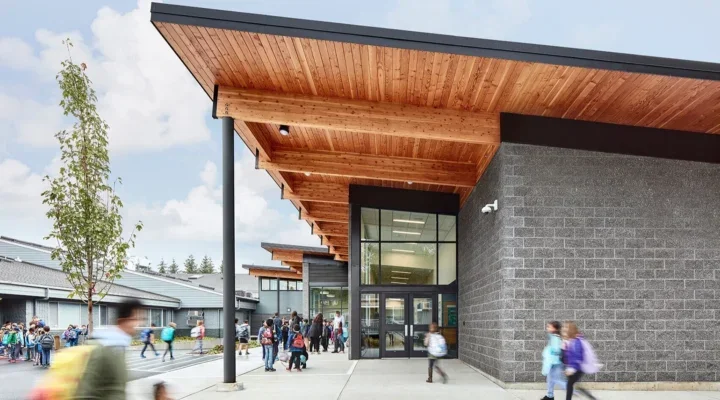
📷: Bassetti Architects
Healthy classroom HVAC: A new school of thought
The latest HVAC research and real-world case studies from the Northwest prove that providing children with healthy, comfortable, and productive learning environments does not require increased energy costs.
By combining the highest performance HVAC equipment with key design principles, advanced performance dedicated outside air systems (DOAS) are a proven way to provide cleaner and safer indoor air, enhance thermal comfort, and reduce HVAC energy use by an average of 69%.[5]
More than a baseline dedicated ventilation setup, advanced performance DOAS:
-
Decouples ventilation from heating and cooling, so ventilation airflow never mixes with the building’s heating and cooling airflow.
-
Uses high efficiency heat/energy recovery to minimize the energy cost of increased ventilation, with design flexibility offered by a variety of readily available qualifying heat/energy recovery ventilators (HRVs/ERVs).
-
Provides controlled, filtered outdoor air at healthy ventilation rates, with efficient conditioning provided by a high-performance heating and cooling system (i.e., electric heat pump, hydronic, or other qualifying high-efficiency equipment).
-
Right-sizes heating and cooling equipment, as decoupled ventilation and recovered heat eliminates the need for equipment to be sized to handle raw outdoor air loads.
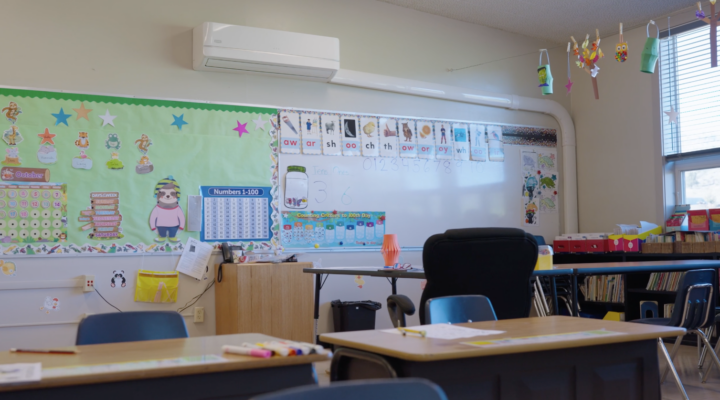
High-performance HVAC for high-performance classrooms
With advanced performance DOAS, K-12 schools are no longer forced to choose between increasing ventilation rates or reducing energy costs. In addition to minimizing HVAC energy use, advanced performance DOAS delivers a host of health benefits:
- Enhanced indoor air quality. Continuous filtered outdoor air, instead of intermittent or recirculated air, reduces pollutants, toxins, and staleness.
- Improved comfort. Temperatures remain stable from room to room, regardless of outdoor conditions.
- Reduced cross-contamination. Less recirculation between spaces helps avoid airflow-mixing risks that come with less rigorous ventilation systems.6
- Stronger resilience to wildfire events. With the right filtration and a smoke-response control sequence in place, schools can function as a clean-air refuge when wildfire smoke invades the air outside.
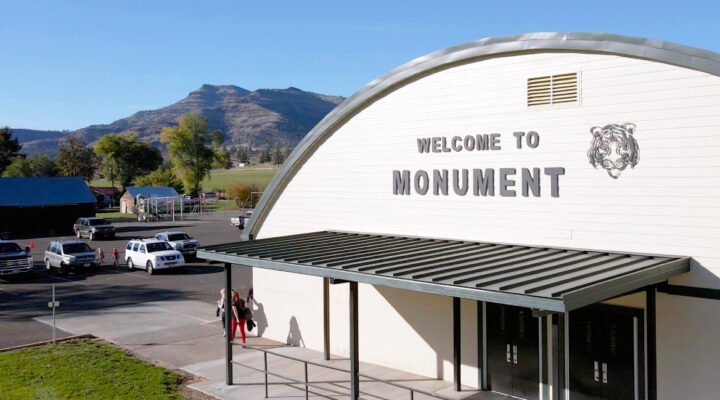
Monument School
Hear from school and utility staff members on how advanced performance DOAS dramatically reduced the rural K-12 school’s monthly energy costs, significantly improved air quality, and provided a more comfortable and productive learning environment.
Upfront costs and lifetime value of advanced performance DOAS
While upfront costs of advanced performance DOAS can be higher than less healthy and less efficient systems, the initial expenditure can be offset over time. For example, significant energy-cost savings, reduced maintenance costs, and minimized system size can have significant budgetary impacts that make the investment well worth it. In addition, many jurisdictions incentivize high-efficiency systems like advanced performance DOAS to further mitigate the upfront cost.
The table below demonstrates the energy-modeled cost expectations of a primary school in Bend, Oregon, showcasing that the lifetime value of advanced performance DOAS offers a meaningful rationale to invest in this best-in-class HVAC approach.
| Metric | Conventional system | Advanced performance DOAS |
|---|---|---|
| Upfront cost | $40.84 / sq. ft. | $53.01 / sq. ft. |
| Annual energy cost | $67,433 / year | $38,857 / year (42% reduction) |
| Equipment size | 3x 22-ton packaged RTUs | 48-ton right-sized high-efficiency heating/cooling equipment and 2x 3,000 cfm HRVs (82% sensible effectiveness) |
| Air-quality approach | Recirculated, semi-filtered air; ventilation coupled to heating/cooling; 3 thermal zones | Decoupled ventilation; MERV-13 filtered air, no recirculation; 17 individually controlled zones |
Will advanced performance DOAS make the grade at your school?
While advanced performance DOAS is a good fit for both new construction and major retrofits, its retrofit feasibility depends on several factors, including available equipment and ductwork space, structural and electrical capacity, and existing distribution systems.
Further, selecting the right advanced performance DOAS equipment is dependent on building size. For example:
- Zonal heat pump systems (e.g., variable refrigerant flow) are typically well suited to smaller schools under 50,000 sq. ft.
- Hydronic configurations (e.g., water-source heat pumps or fan-coil units) work well in larger secondary schools, 80,000 sq. ft. and up.
- Either zonal heat pump or hydronic configurations can serve larger schools in the 75,000 – 200,000 sq. ft. range, depending on the specifics of the building.
Advanced performance DOAS is also a good fit for buildings grappling with indoor air quality concerns and ventilation challenges, or otherwise seeking to provide healthier learning environments.
[1] Center on the Developing Child, Harvard University, 2025.
[2] EPA, Reference Guide for Indoor Air Quality in Schools.
[3] EPA, Wildfires and Indoor Air Quality in Schools and Commercial Buildings.
[4] EPA, Volatile Organic Compounds’ Impact on Indoor Air Quality
[5] When compared to a code-minimum version of the existing equipment (often a packaged rooftop unit). Data based on 12 demonstration projects in small-to-medium commercial buildings throughout the Northwest.
[6] ASHRAE TC 5.5, Practical Guidance for Epidemic Operation of ERVs.
Explore Northwest case studies
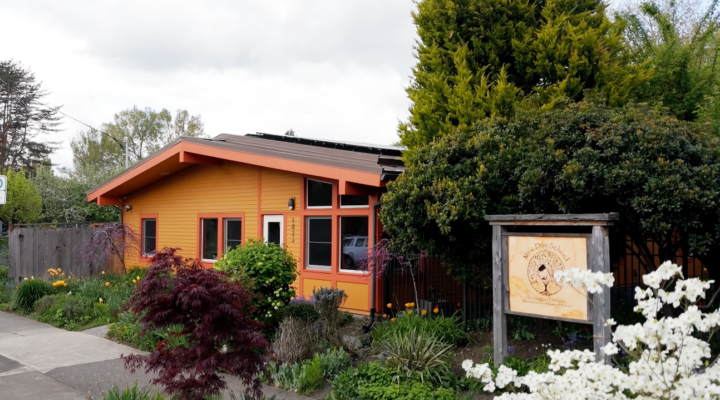
Preschool prioritizes healthy, mindful HVAC decisions
New-school HVAC approach improves comfort and air quality for K-12 students
Lewis & Clark student center blazes new trail to HVAC efficiency