
Seattle-based Principal Architect Kristian Kicinski discusses the role of high-performance HVAC in his pursuit of energy efficiency and sustainable design for K-12 schools.
A conversation with Kristian Kicinski, Principal Architect at Bassetti Architects (now a design studio of HMC Architects), on the ways advanced performance HVAC provides optimal learning environments for schoolchildren, including by enhancing thermal comfort and indoor air quality.
What role does HVAC play in the overall design of a school building?
As the former Director of Sustainability at Bassetti Architects, I have long held a passion for sustainable design. HVAC plays a very important role in the pursuit of energy-efficient buildings, and it also plays a crucial role in occupant health and comfort.
At Bassetti, we work largely in the K-12 school space, so we’re very committed to making HVAC decisions that provide optimal learning environments for students. If they aren’t comfortable, it’s very difficult for them to learn. If the air quality is bad, it negatively affects the students’ performance as well as the teacher’s. Finding the right HVAC solution is a critical piece to designing a healthy, energy-efficient school, and it’s integral to our approach.
Have you noticed any recent trends or shifts in perspective regarding HVAC in schools?
There’s been a turning of the tide over the last 10 years. It used to be that schools would want a like-for-like replacement of their existing HVAC system. They were used to it, and they liked it the way it was. However, with advancing codes, we are now able to discuss alternative advanced-performance options, like dedicated outside air systems (DOAS), that can help them meet code and bring a host of additional benefits, including reduced operational costs and increased student comfort.
Another changing factor has been a focus on indoor air quality. With wildfires increasing in frequency in the Northwest and California every summer, schools are looking for an HVAC solution that will help them provide clean, filtered air so they don’t have to shut down the building when there’s wildfire smoke in the air.
In addition, the shifting climate means air conditioning is a must during the summer to maintain thermal comfort. The conversation then becomes fairly easy because heat pumps and advanced-performance HVAC increase energy efficiency compared to outdated systems, while also providing air conditioning.
Now, the conversation with schools isn’t about convincing them of the value of advanced-performance HVAC. Instead, the conversation becomes: which advanced approach are we going to use? Is it going to be a split-system, variable-refrigerant flow (VRF), or centralized air-source heat pumps? Or maybe ground-source heat pumps? Either way, the advancing codes and changing conditions have really refocused the conversation in a good way.
How do schools benefit from fully separating heating and cooling from ventilation air?
Providing schools with 100% outside air with no recycling is a crucial way to improve classroom air quality and reduce viral spread. When schools learn that this approach delivers fresh air directly into their classrooms and sends stale air outside with no crossover, they are completely on board. It’s a steady stream of outside air—who wouldn’t want that? Particularly with the recent pandemic, the decoupling approach has become embraced by the industry as a great way to improve classrooms from a health standpoint.
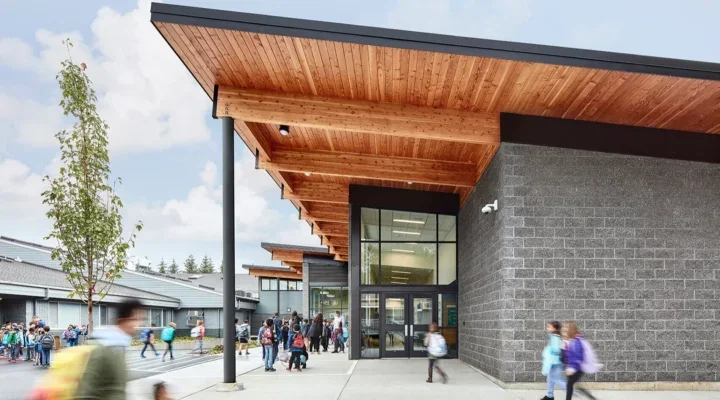
📷: Bassetti Architects
How have you seen Washington state’s advancing codes change your projects in schools?
I really appreciate the ability of energy code to drive efficiency forward. It truly does change the conversation. When certain inefficient systems are no longer code compliant, they’re off the table. And with those approaches off the table, we can focus on advanced-performance HVAC systems that meet these more stringent codes while also creating the best indoor learning environments.
It makes the decision-making easy—why wouldn’t schools want fresh, healthy air and better thermal comfort for their students, teachers, and staff? When the energy codes get higher, it raises the bar in so many positive ways. From that standpoint, I’m a huge fan of Washington state’s energy code.
To learn more about advanced performance DOAS, visit betterbricks.com/apdoas.